


The Redundancy Myth That Threatens BioPharma & Life Sciences Cold Storage
%20(1).jpeg)
Understanding N+1 Redundancy
N+1 redundancy is a common strategy designed to ensure uninterrupted operation in the event of system failures. Here’s how it works: if a facility requires five walk-in freezers (N=5), then there should be six (N+1) available in total—five active and one on standby. If one freezer needs to be shut down for maintenance, the products could be moved to redundant space. (The outcome is less rosy if two freezers fail.)
Commercial refrigerators and freezers typically use redundant components (compressors, evaporators, condensers, control systems, etc.) to protect against sudden failures and reduce wear and tear. Modern refrigeration systems feature built-in control systems that detect malfunctions and automatically switch to the redundant component. This leads to one of the major problems with redundant systems.
The Problems with N+1 Redundancy
Current Good Manufacturing Processes (cGMP) require, at a minimum, that facilities monitor the temperature inside each refrigerated chamber. When only the temperature is monitored, it’s easy to miss a developing problem, for example, where one compressor fails and the redundant one is switched on automatically.
This is a precarious situation because there is now a single point of failure that may not be immediately apparent. The working compressor maintains the proper temperature in the chamber, so there is no alert, but there is also no redundancy. Left unchecked, the lone operating compressor—which is now working overtime—will inevitably fail, leading to (at best) an emergency product move or (at worst) loss of product. This is the redundancy myth: With N+1 redundancy, the moment the redundant system is activated, you no longer have redundancy.
This predicament requires immediate emergency repairs to replace the failed component and restore redundancy.
The Nature of N+1 Redundancy
N+1 systems are designed to tolerate only one failure, after which the system becomes vulnerable again. When multiple components fail simultaneously, or a cold storage facility experiences a cascading failure—where one fault triggers another, a spare system won’t be sufficient to maintain the required chamber conditions. Misguided reliance on N+1 alone assumes that the risks and conditions faced by cold storage facilities are static and predictable. This assumption is not only wrong, but it continues to have devastating consequences across the BioPharma and Life Sciences industry.
Many N+1 setups fail to account for external factors such as extreme weather conditions, sudden power outages, or human errors, like leaving a freezer door open. Consider a scenario in which a facility is storing millions of dollars of biologics during an unexpected heatwave. The combination of increased ambient temperature and power fluctuations can put additional strain on multiple cooling systems and stress them to their breaking points. This is a precarious situation that underscores the importance of having redundant systems at the ready, which will not be the case if they are already deployed. This is where predictive maintenance tools, like OverShield, save the day by providing deep insights that identify these developing problems in advance.
Predictive Maintenance — The New Gold Standard
In cold storage facilities, N+1 systems are popular due to their simplicity, cost-effectiveness, and ability to meet regulatory requirements. They strike a balance between operational reliability and financial feasibility, making them an attractive option. However, as mentioned earlier, this strategy often relies on narrowly scoped risk assessments, failing to account for the complex, real-world challenges that arise. While N+1 redundancy can provide adequate protection under ideal conditions, it is insufficient for the uncertainties of the real world.
For redundancy to be reliable, the health of the entire system must be maintained so that the redundant chamber/component is ready when needed. It is no longer rational to only monitor conditions inside a chamber and conclude that the system is running optimally as long as the temperature remains within the specified range.
Facilities that have installed OverShield immediately discovered that over 30% of their chambers were not operating at peak efficiency, indicating that unknown problems were not being addressed. This finding is consistent with broader studies that found refrigeration systems in large cold storage facilities often operate below optimal efficiency due to component malfunctions. Issues with defrosting mechanisms alone can lead to an increase in energy usage of up to 18.3%. The only way to achieve a comprehensive view of your refrigeration system is to implement a premier predictive maintenance solution like OverShield.
How it Works
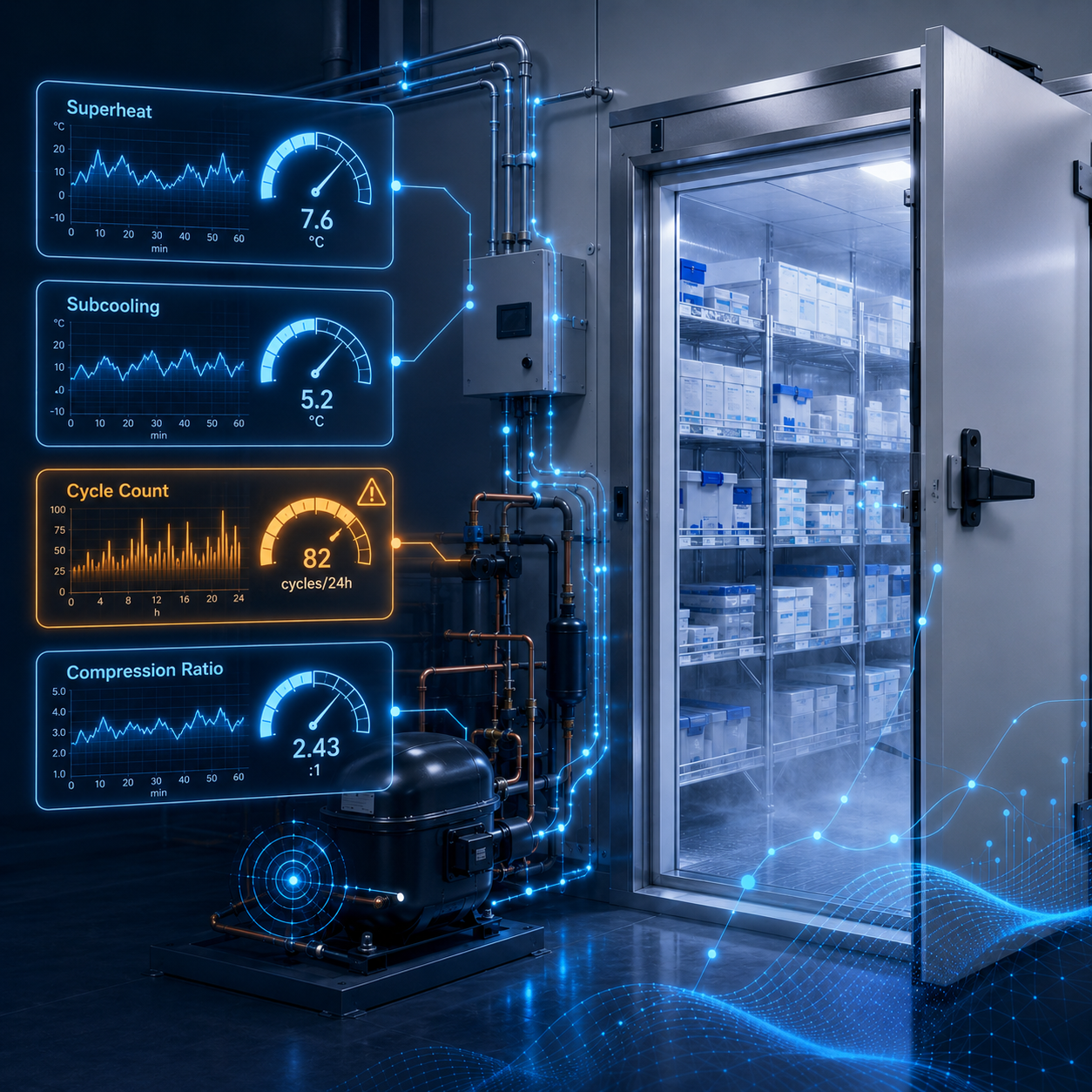
OverShield collects sensor data from various refrigeration components and uses AI-powered data analytics to assess the overall health of each chamber. By monitoring temperatures, pressures, electrical current, and other parameters at strategic locations, mechanical and electrical problems can be identified, pinpointed, and proactively repaired before they progress to a situation where a critical component suffers a mechanical failure. Weekly reports provide facility staff with the health status of each chamber, allowing them to identify performance trends and prioritize and schedule maintenance accordingly.
OverShield doesn’t replace a viable redundancy strategy; it ensures that the redundant systems are available and operate optimally whenever they are needed, providing the highest possible level of protection for cold-storage products. In other words, predictive maintenance eliminates the core vulnerabilities of N+1 redundancy, transforming inefficiency into reliability.
Planning a Successful Redundancy Strategy
Beyond having redundant components in each refrigeration system, it is also essential to have a sufficient number of redundant chambers as backups to facilitate emergency product moves.
Planning a redundancy strategy is actually quite simple—but executing on that strategy is where many facilities tend to fail. In general, you should have 10% (minimum) redundant chambers, and optimally 20%. That means if you’re operating 20 chambers in one facility, only 16-18 of them should contain product. The remaining chambers should be at the ready and maintained at the required temperature in case an emergency occurs. The redundant chambers should mirror the primary chambers, meaning if you have ten 5°C chambers and ten -40°C chambers in your facility, you should allocate two redundant chambers of each type.
Where Things Go Wrong
Having a redundant chamber is like having a spare closet; it doesn’t remain a “spare” for long. If you have it, you’ll use it, and that is where many storage facilities unknowingly put their products at risk. When one or more chambers inevitably require emergency maintenance and products need to be moved, that is not the time to discover that the designated “redundant” chambers are occupied. Beyond the chaos, there is the potential for complete product loss. To avoid this, it is essential that facility managers routinely inventory their chambers and physically confirm that at least 10-20% of their chambers are reserved for redundancy.
Conclusion
The life sciences industry cannot afford to take risks with cold storage systems and the valuable products they store. Short of moving to fully redundant refrigeration systems (which are costly in terms of implementation and real estate), the future of cold storage lies in multilayered systems that support N+1 redundancy backed by early warnings and proactive maintenance.
While N+1 redundancy offers a valuable blueprint for reliability, its limitations make it insufficient for the high-stakes demands of vaccine and drug preservation. The stakes are too high—financially, operationally, and most importantly, in terms of public health. Investing in robust, predictive systems like OverShield is not optional; it is essential.
Still Relying on Redundancy? You Need OverShield.
See OverShield in Action

Outcomes